Why Most MVPs Fail Before They Ever Reach the Market
An MVP is supposed to help you learn what customers actually need. But many teams turn their first version into a smaller version of the final product—and end up spending months building something nobody asked for.
An MVP is not about building less software. It is about learning more with less investment.
What an MVP Is Actually Supposed to Do
The purpose of an MVP is to test your most important product assumptions with real users as early as possible.
It should answer a critical question: Does this solution create enough value for the target customer?
If your first version takes six months to build before anyone can use it, you may have already waited too long to validate the idea.
Why MVPs Commonly Fail
Building too many features
Teams often confuse an MVP with a feature-complete product. They add dashboards, notifications, integrations, admin panels, automation and edge cases before proving that the core experience works.
Every additional feature increases development time and makes it harder to understand what actually created value for the customer.
Starting development before validation
Writing code feels like progress, but code does not validate a business assumption.
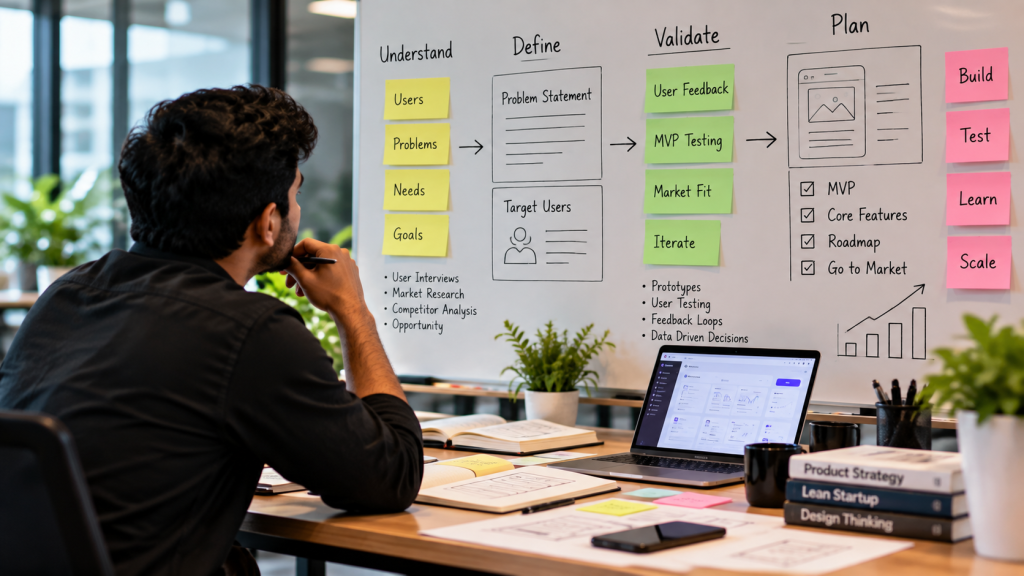
Before development begins, teams should understand the customer, the problem, the existing alternatives and why someone would change their current behaviour.
Trying to make the MVP perfect
A first version does not need to be perfect. It needs to be useful enough for real users to interact with it and provide meaningful feedback.
Spending weeks polishing features that have not been validated can create a false sense of progress.
Solving too broad a problem
If your MVP tries to solve five different problems for five different customer segments, it becomes difficult to determine who the product is actually for.
Start with one clear customer and one important problem. Expand after you have evidence that the core solution works.
No clear definition of success
Launching an MVP without knowing what you are trying to learn creates confusion.
Define the behaviour or outcome that would indicate that the product is solving a meaningful problem.
Start With Your Riskiest Assumption
Every product idea contains assumptions.
Maybe you believe customers will pay for the product. Maybe you believe they have the problem frequently enough. Maybe you believe they will change their existing workflow.
Identify the assumption that could kill the product if it turns out to be wrong—and test that assumption first.
Don't build the MVP around what is easiest to develop. Build it around what you need to learn.
What Should Actually Be in an MVP?
A good MVP contains only the capabilities required to deliver the core value proposition and test the most important assumptions.
- One clearly defined target customer
- One important customer problem
- A focused core workflow
- The minimum features required to complete that workflow
- A way to measure customer behaviour and feedback
Everything else should be questioned.
Manual Work Can Be Part of Your MVP
Not everything needs to be automated from day one.
In some cases, a process that will eventually be automated can initially be handled manually behind the scenes.
This allows you to test whether customers actually value the outcome before investing heavily in automation and infrastructure.
Launch, Learn, Then Improve
Your first launch should create a feedback loop.
- Observe how users actually use the product.
- Identify where they struggle.
- Understand which features they repeatedly use.
- Talk to users about what they expected.
- Measure whether the product is producing the intended outcome.
Then use those insights to decide what to build next.
The MVP Is the Beginning, Not the Destination
A successful MVP doesn't mean you have built the final product. It means you have reduced enough uncertainty to make the next product decision with better information.
The strongest product teams don't try to predict everything upfront. They create a focused first version, put it in front of users, learn quickly and continuously improve the product based on evidence.
The goal of an MVP isn't to prove that your idea is perfect. It's to discover whether the idea deserves to be built further.
Before You Build Your MVP, Ask These Questions
- Who exactly are we building for?
- What is the most important problem we are solving?
- What evidence do we have that this problem matters?
- What is the riskiest assumption?
- What is the smallest version that can test it?
- What will we measure after launch?
- What would make us change direction?
Build Less. Learn Faster.
A well-designed MVP can save months of development by helping you discover what customers actually want before you commit significant resources to the wrong product.
The best MVP is not necessarily the one with the fewest features. It is the one that generates the most useful learning with the least unnecessary investment.
Planning an MVP?
We help businesses turn ideas into focused product strategies, validate assumptions and define MVPs that are ready for execution.
Talk to Odylabs →